
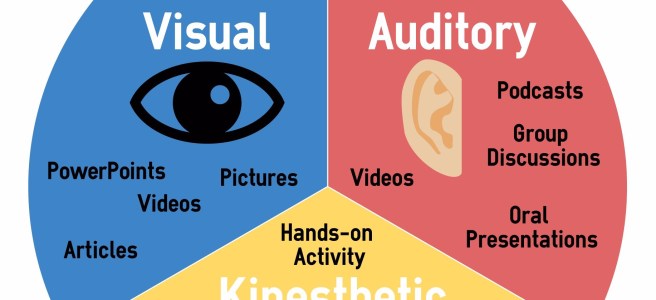
Looking back on my elementary education, I don’t remember my instruction being differentiated. However, this is very important in education. Differentiated instruction allows students to have multiple ways of learning and expressing the ways they’ve learned (Tompkins, 2018). In my classroom, I plan on having students take the learning style inventory at the beginning of the year to assess how they learn best. I remember taking this inventory recently and my dominant style of learning has changed from when I was getting my undergraduate degree.
Differentiated instruction is especially helpful for students that are struggling with reading and writing. Tompkins (2018) offers an excellent chart that outlines the various problems and solutions for struggling readers and writers. These are a few examples:
Struggling Readers
Problem: Decoding
Student can’t identify high-frequency words
Solutions: Make a personal word wall with words the student recognizes, use a routine to teach and practice high frequency words, Ask the student to look for high frequency words in familiar books
Struggling Writers
Problem: Ideas
Student complains by saying, “I don’t know what to write”
Solutions: Have the student brainstorm a list of ideas and pick the most promising one, Invite the student to talk with classmates to get ideas
I highly recommend getting a chance to look at the problems and solutions outlined on Pages 386-389. As a new teacher, I will be starting a journal to record these.
One of the key aspects of differentiated instruction is that it should be rigorous, relevant, and flexible (Tompkins, 2018, p.371). There may be misconceptions that differentiated instruction makes the tasks “easier” for some students. This is not the case at all! It allows students to be recognized for where they are at. One of the visuals Tompkins outlined was that of a ladder, where the upper rung has advanced learners, the middle rung has grade-level learners, and the lower rung has struggling learners. Activities should vary depending on the learner. This is called tiered activities.
Literacy centers are another great tool in the classroom for offering differentiated instruction. I’ve had the opportunity to see a variety of literacy centers in different grade levels. Students are able to try a variety of activities that support their needs. Some of the examples Tompkins (2018) outlines are the alphabet center where students practice the ABC song and read books, the computer center where students do word processing and research, and the pocket charts center where students arrange sentence strips for a poem or song, then read or sing it.
I strive to create a classroom filled with a community of learners that fit their various needs. I hope you enjoyed reading and I look forward to hearing your advice for ways that you differentiate instruction! Thanks for reading!
Reference: Tompkins, G. E. (2018). Literacy for the 21st century: A balanced approach 7th Ed. New York: Pearson.


Hello, I agree that word walls help with clarity and better understanding for students who need additional help with high frequency words. I also have created word walls for each unit to help students with clarity on what they don’t understand. I also feel that CFU’s are also helpful in making sure all students know what they are doing. making sure all students with different needs understand prior to completing any assignment is also important in making sure any assessment is accurate. I also like the idea of learning centers for kids with specific needs, they will have the option to choose what support they need. I feel that this also creates a good classroom climate that is warming and accepting for students to strive in learning.
LikeLike
Learning style inventories are great to have students complete at the beginning of the school year. Not only is it useful for us as teachers but it will benefit them to understand how they learn. Having students brainstorm ideas of what to write when they “don’t know what to write” is a good idea. I find that often times it’s not always that they don’t know they just need to think about it. Most of my students need to practice brainstorming more because if given a writing prompt and they don’t immediately have an answer they believe it’s because they don’t know or can’t answer the question. I tell them all the time you have to think about it. Good job!
LikeLike