
 Article Review
Winn, M.T. (2018). A transformative justice approach to literacy education. Journal of Adolescent & Adult Literacy 62(1), 101-104. Retrieved from: https://ila.onlinelibrary.wiley.com/doi/full/10.1002/jaal.887
Restorative justice is one of the buzz words in education in recent years. While restorative justice is sometimes presented as an alternative to expulsions or suspensions in school, it should really be utilized to create a school community culture. The authors suggest using restorative justice as a lens for educators to view their relationship, roles, and responsibilities to students. Restorative English education “seeks to create and sustain writing, reading thinking and action-oriented communities in which children, youths, and educators can cultivate purposeful literate identities and trajectories” (Winn, 2018, p. 219).
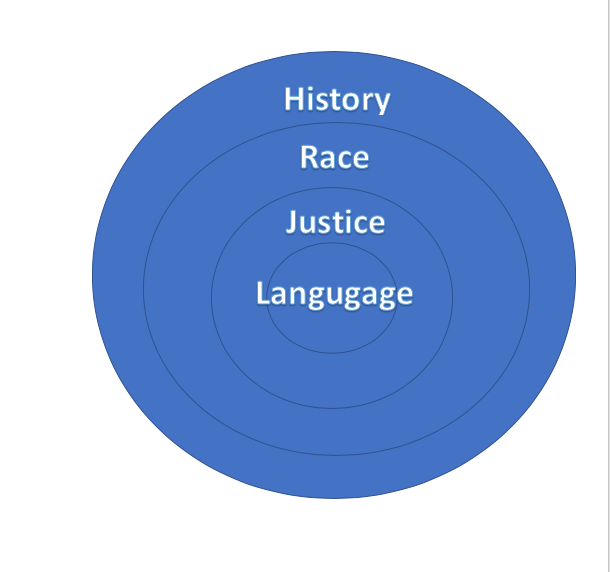
The image above illustrates the four pedagogical stances that the author outlines using fifteen years of fieldwork in literacy communities, both inside and outside school spaces and conducting histographies. The outside circle, history matters, compels educators and students to understand “local, state, local, state, national, and global histories that provide context for relationships” (Winn, 2018, p.220). One of the ways to gather history is to interview family members and producing work that belongs to the student as well as the community.
The second circle, race matters, compels educators to “walk boldly into meaningful discussions of race by naming and defining themselves and determining their futures” (Winn, 2018, p.221). This can be difficult for educators, and I will admit this is something that I struggle with as an educator. However, by developing critical vocabularies to engage in these conversations, we can move towards transformation. Addressing harm is a critical component in restorative justice and this step, while uncomfortable, should not be ignored. This allows us to move forward to the third circle, justice.
Finally, the inner circle for language, is at the heart of this work. I was most moved by this piece, as the author asks educators if “we will listen with filters of correctness and appropriateness or embody stances that support their (students) goals for articulating their dreams, ideas, and intentions” (Winn, 2018, p. 221). I love this quote! As educators, we have state standards to teach. However, we must not lose what is at the heart of teaching. Students are filled with thoughts, ideas, histories, and we must allow them to articulate these without restrictions. It reminds me of the last article that I reviewed. Check out the post if you haven’t yet: https://alwayslearningwhileteaching.school.blog/2018/11/15/article-review-sustaining-multilingual-literacies-in-classrooms-and-beyond/
As educators, we need to develop relationships with our students and critically think about how our classrooms are set up to engage with students. We need to decolonize any practices in our classrooms that do not promote learning as relational. Another point that the authors made that I want to utilize is to for our students “to use their writing to invite others to the table they set” (Winn, 2018, p. 220). I hope you enjoyed the review as I learned a great deal! If you have the chance, I hope that you read the article in its entirety. It’s only three pages and a great tool if you are interested in using the restorative justice framework in literacy practices in your classroom.


