
Comprehension involves reader factors, as well as text factors. I’ll be going over text factors in this post. According to Tompkins (2018), there are three types of text factors: genres, text structures, and text features (p.294). When students understand text factors, this can serve as a scaffold to make comprehension easier.
As teachers, it is important that we go over text factors with our students so they understand the different genres, structures and features while reading. First, genres are the broad categories in literature and include stories, informational books or nonfiction, and poetry. Within these genres are subgenres, such as fables, myths, and legends within the genre of folklore. Each of these genres or subgenres have similar characteristics that students can identify. As teachers, we can go over these through minilessons.
Stories have text structures that are unique from other genres. The most important story elements, as outlined by Tompkins (2018) are plot, characters, setting, point of view, and theme (p. 299). The most basic aspect of plot is beginning, middle, and end. I attended a workshop in February from the People’s Education Conference (https://www.facebook.com/thepeoples.ed/), where I was exposed to the ESPSP framework. Traditional story plots are outlined as exposition, rising action, climax, falling action, and resolution. However, Currameng, Lopez, and Tintiangco-Cubales (2016) have created the Ethnic Studies Praxis Story Plot (ESPSP): expose the problem, oppressive action, trauma/tension, taking action/resistance/healing, and revolution and reflection. The Ethnic Studies Praxis Story plot offers greater critical thinking, as well as serves “students in more socially just and community responsive ways.”
Tompkins (2018) used a very helpful chart to outline the five expository text structures alongside the graphic organizer type (p. 309) (see below)
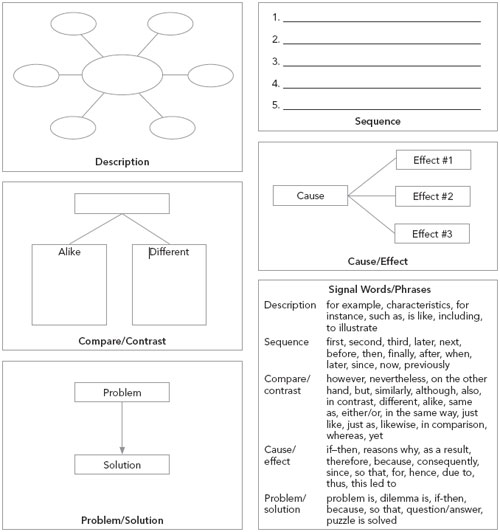
When graphic organizers are used, it helps provide a guideline for students to organize the information in a visual way. I will definitely be using these in my own teaching practices. Even as I read Tompkins (2018), it is imperative that I utilize the text features to help me take notes and disseminate the information more easily. I usually outline my notes using the headers and sub-headers and make note of the graphs. There is even a pattern to the colors used for different diagrams in Tompkins (2018). For example, booklists are green and graphs with categories are in yellow. It is important that we utilize all the different features to aid our learning and understanding so that we can work towards comprehension.
References:
Curammeng, E.R., Lopez, D., Tintiangco-Cuables, A. (2016). Community responsive literacies: The development of the ethnic studies praxis story plot. English Teaching: Practice & Critique, 15(3), 411-429.
Tompkins, G. E. (2018). Literacy for the 21st century: A balanced approach 7thEd. New York: Pearson.


Hi Ariana,
I have to agree with you, graphic organizers help students comprehend the information using visuals. Growing up, I was one of those students who believed graphic organizers were helpful. Even now as a graduate student I use graphic organizers to help me understand reading materials. As a kindergarten teacher, I use simple graphic organizers in the classroom. The bubbles are normally filled in with one word or simple drawing.
Thank you for sharing,
Abigail
LikeLike
Hey Ariana. I agree that the use of graphic organizers are extremely important when help students learn new information about text. Graphic organizers can be modified and used for all grade levels. I agree how vital it is that we use all aspects of texts to aid understanding.
LikeLike
Hi Ariana, I love graphic organizers!! They benefit so many different types of learners. It is nice to see that you are willing to learn new things by going to workshops. I myself am a visual learner and I would definitely benefit from graphic organizers. These graphic organizers are not just beneficial in elementary, middle, and high school; they are also beneficial in higher education. Providing students with graphic organizers helps students visually and linguistically. Graphic organizers according to Tompkins acts also as a scaffold for students.
Thank you for sharing your insight and for providing our students with the tools they need to be successful.
LikeLike