
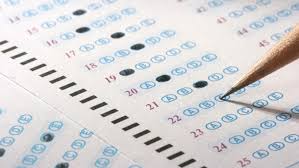
When you see the words “assessment” and “evaluation,” do you think of them being interchangeable? I used to think that was the case, but when it comes to teaching, they are quite different. Assessments are ongoing and allow for immediate feedback. Whereas evaluations are summative and usually given at the end of a unit.
As a student, I had a great deal of anxiety when it came to testing. I would create detailed study guides for tests and make sure that I studied as much as I could. I wanted to do as well as possible and always shoot for an “A.” After the test, the likelihood that I would actually retain this information was pretty slim. Now that I’m entering the teaching profession, I want to move away from testing my students in way that their focus is on the test, or evaluation.
Tompkins (2018) outlines four steps to help guide assessments: planning for assessment, monitoring students’ progress, evaluating students’ learning, and reflecting on students’ learning. The two steps that stood out to me were Step 2: Monitoring Students’ Progress and Step 4: Reflecting on students’ learning. These two steps, before and after the evaluation, can be transformative for students. If I had time to reflect on my understandings, rather than ending with a test, I may have had a great opportunity to retain more information. Step 2, while time consuming for teachers, is imperative to make sure if scaffolding needs to take place for any students. When this is completed before the evaluation, it allows students greater opportunities to ask questions and as a teacher, helps to check for understanding. I do not want my students to feel that they are only learning material to pass a test or evaluation. I want my students to be engaged and able to use their knowledge outside the classroom.
Advancements in technology have allowed many tools to be created to determine students’ reading levels, such as the Developmental Reading Assessment, Fountas & Pinnell Benchmark Assessment, and the Scholastic Reading Inventory (Tompkins, 2019, p.85). For those in the classroom, have you found any particular tools to be helpful?
Finally, high-stakes testing is something that I struggle with as an aspiring teacher. This is something that unfortunately is mandated in schools. I remember when the California High School Exit Exam was introduced and the anxiety I felt when I was a student. I want to give my students testing strategies to help ease their stress and anxiety when it comes to testing. I hope that high-stakes testing will be eventually eliminated, but understand that this is something that both teachers and students must face in the meantime. Are there any testing strategies that you recommend in your classroom?
Reference: Tompkins, G. E. (2018). Literacy for the 21st century: A balanced approach 7th Ed. New York: Pearson.


I was also confused on “assessment and “evaluation” thinking they were interchangeable until you realize you specifically use them individually for a purpose. Education has unfortunately misguided many students to the true understanding and critical thinking of content. My entire educational experience has been to master a standard or a test. This is not the point of education but rather mold an innovative mind to challenge or combat the status quo when it is wrong or incorrect. The focus on test should be a thing of the past but unfortunately still exist among education today. I feel that it is important to first understand what our students are able to do and what they can’t. We as educators should always meet students where they are at academically and cognitively. So when your evaluating a group of students you can push them to a point where you know they can struggle but at the same time work through that struggle for progression. I believe it’s imperative for educators to incorporate technology in the classroom. This creates for some relevance among students and to better engage them on the lesson so the assessment can be as accurate as possible. A student might be having an “off day” and not be doing well with your assessment but recognizing this struggle to have a quick conference strategy can be both beneficial for teacher and student relationship.
LikeLike
All students develop anxiety when testing. But moving away from testing will be difficult in some areas. Students need to be able to know that they must retain the information being present to them for future needs. Scaffolding works great if you use it throughout the year. Building on your curriculum helps students become more prepared as they will apply the current information to the next.
LikeLike